01 / INGEST
CAD-aware import
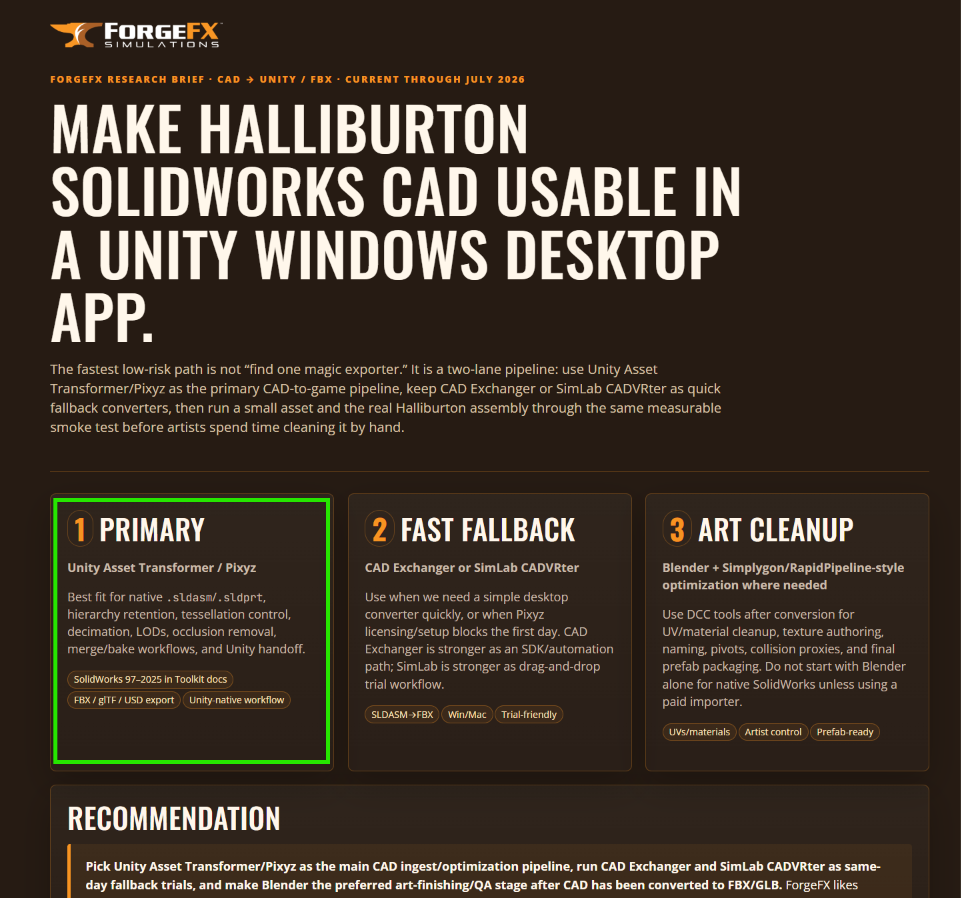
Primary: Unity Asset Transformer / Pixyz. Fallbacks: CAD Exchanger, SimLab, Okino. Preserve assembly references and source metadata.
 READ THE 100-WORD VERSION →
The target is not merely “opens in Unity.” ForgeCAD exists to produce intelligent, human-editable, VR-ready geometry with correct structure, units, pivots, UVs, and textures—and to prove quality with a repeatable 0–100 judge.
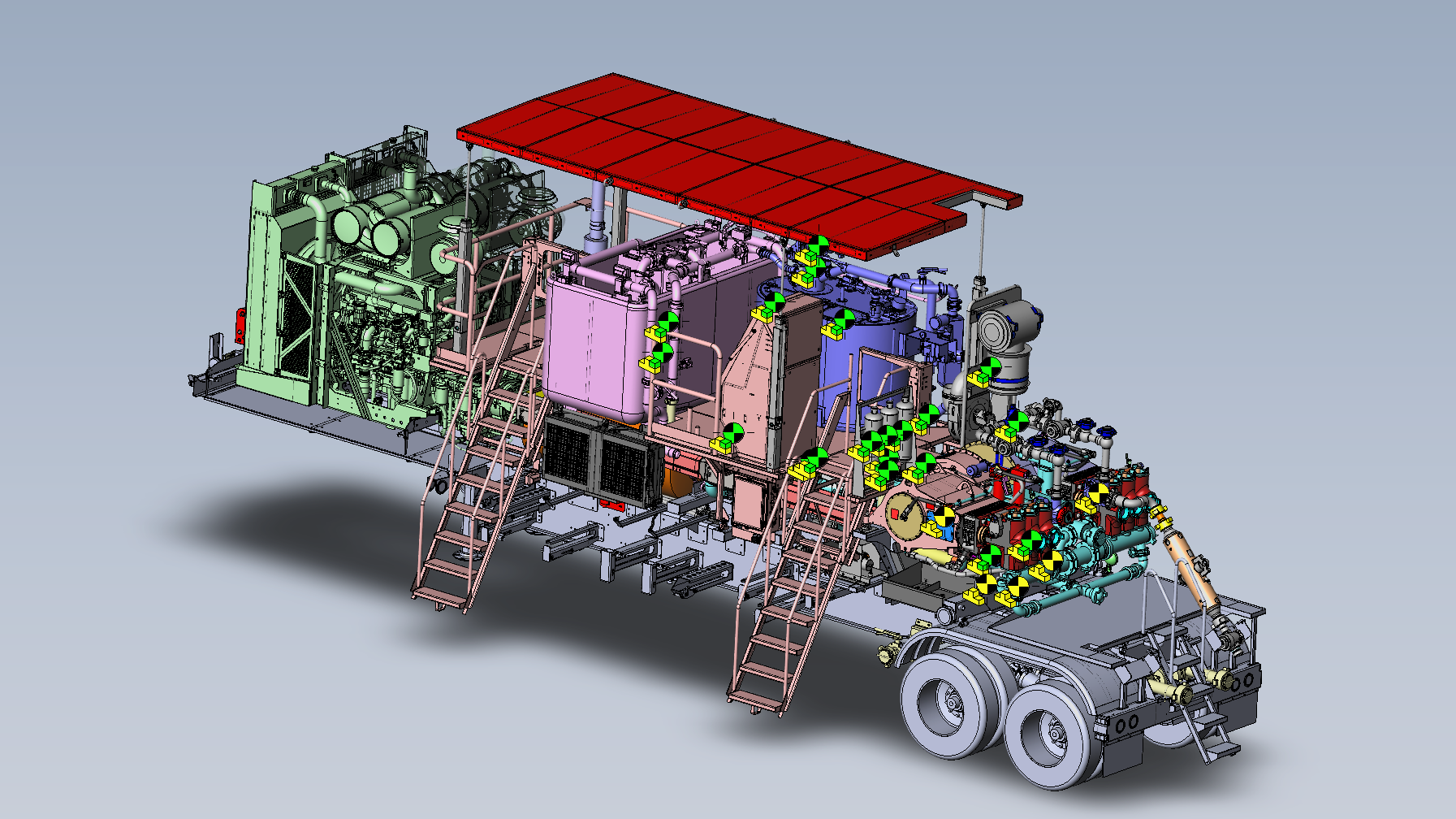
CAD tessellation can preserve the shape while destroying the model’s usefulness: dense cloth-like topology, meaningless object trees, bad pivots, arbitrary scale, overlapping UVs, and baked-looking materials. Dave’s standard is tougher: the output must run in VR and remain legible and editable to an artist who needs to select a part, move an axis, add a label, revise a texture, or optimize a subassembly.
Use CAD-aware ingestion first, art-aware cleanup second, runtime proof third. The same manifest and judge follow every candidate so tool changes remain comparable.
Primary: Unity Asset Transformer / Pixyz. Fallbacks: CAD Exchanger, SimLab, Okino. Preserve assembly references and source metadata.
Retessellate, remove hidden internals where allowed, generate LODs, merge only static groups, and retain interactive parts separately.
Use Blender or the winning DCC lane for naming, pivots, UV layout, materials, texture authoring, collisions, and final inspection.
Import into a clean Unity test scene, profile target VR behavior, run automated checks, then complete a blinded artist review.
Each rung advances only after the prior rung passes. This isolates failure causes and turns every conversion into reusable evidence instead of one heroic cleanup.
The roll-up uses fixed weights. A high texture score cannot conceal broken geometry; hard gates cap a result that is unusable in practice.
Each candidate produces the same evidence bundle: source manifest, conversion logs, mesh statistics, UV checks, material inventory, runtime profile, turntable captures, and a human-editability task sheet.
Dave’s July 8 message points back to the Halliburton “Elite phase 1 batch.” Direct Graph inspection resolves that folder to the 3.43 GB archive below. We do not start there; we preserve it as the graduation test.
| Evidence | Verified state |
|---|---|
| Slack source | VERIFIED Dave: “grab this CAD file” for AI geometry, initial texture, and UV mapping. |
| Folder | VERIFIED Elite phase 1 batch; 3,957,000,076 bytes total. |
| Holy grail archive | VERIFIED D00416063-Tier4-I_2026_07_07.zip; 3,433,599,308 bytes (3.43 GB / 3.20 GiB). |
| Source formats | THREAD-EVIDENCED SolidWorks SLDASM and SLDPRT with assembly references. |
| Current conversion | NOT CLAIMED Identified, not yet judged as a ForgeCAD pass. |
The site becomes the operating scoreboard: mission, benchmark ladder, current candidate, evidence, per-constraint judge, final score, failures, and the exact next experiment. No generic product marketing and no unverified “AI converted it” claims.
Input manifest · converter and settings · elapsed time · before/after stats · turntable images · Unity profile · artist task results · eight subscores · weighted final score · hard-gate status · fix list.
Advance to the next asset only when the current asset scores at least 80/100, triggers no hard gate, and a human artist confirms the geometry and UVs are editable without reconstruction.